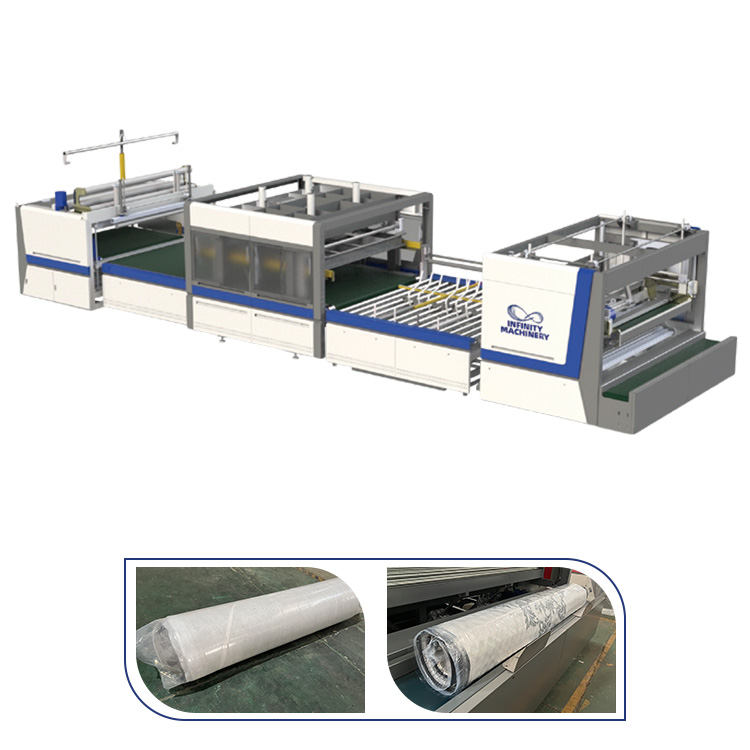
The heavy compress packer is the machine that makes the export mattress factory, and the light domestic packer cannot do the export job. The export shipment needs the mattress compressed to the compact fraction, held under the vacuum, wrapped, folded and boxed at the rate that fills the container, and the heavy machine carries the compression force, the heavy frame, the continuous-duty hydraulics and the export-grade film system that the light packer lacks. The heavy machine compresses the thicker and the larger mattresses (the 30-40 cm queen and king cores) to the target ratio without the frame flex, runs the thousands of cycles per month without the breakdown and produces the boxed unit that fits the container at the two to the four times the density of the uncompressed shipment. The IF-BCR8 Full Automatic Compress Fold Roll Packing Line, the IF-MF29 Multi Fold Compression Packing Machine and the IF-CR2 Automatic Roll Packing Machine are the heavy export-class machines that the export factory runs.
The heavy compress packer does the export job that the light domestic packer is not built to do, and the difference is the force, the frame and the duty cycle. The compression force is the first difference: the export mattress core (the 30-40 cm queen and king) needs the force to reach the target ratio, and the heavy machine delivers the force through the hydraulic press while the light packer stalls or flexes at the thick core. The frame stiffness is the second difference: the compression force pushes against the frame, and the heavy machine carries the boxed-steel frame that holds the platen parallel while the light frame flexes, tilts the platen and compresses the mattress unevenly. The continuous duty is the third difference: the export line runs the shifts back-to-back at the container-loading pace, and the heavy machine carries the oversized hydraulics, the geared drive and the industrial bearings that run the thousand cycles per month, while the light machine overheats and breaks down under the continuous run. The control depth is the fourth difference: the heavy machine sets the compression ratio, the hold time and the release curve per the mattress spec, and the export line dials the protocol per the order while the light machine runs the single fixed cycle. The size envelope is the fifth difference: the heavy machine takes the king and the super-king sizes with the room to spare, and the export order mix that includes the large sizes needs the envelope that the light machine cannot accept. The heavy rule: the force, the frame, the duty cycle, the control and the size envelope together are the export class, and the factory that ships the thick cores at the container pace runs the heavy machine.
The compression force and the frame are the physics of the thick export core, and the numbers explain why the heavy machine is the export standard. The force requirement is the first number: the 30-40 cm mattress core compressed to the 25-30 percent of the height needs the force proportional to the cross-section and the resistance, and the queen core at the target ratio runs the force in the tens of tons that the light machine cannot sustain. The frame loading is the second number: the force acts on the frame as the tension, and the frame must carry the load without the deflection that misaligns the platen, and the boxed-steel construction with the gussets and the tie bars holds the deflection to the fraction of the millimeter. The platen parallelism is the third number: the top and the bottom platens must stay parallel within the tolerance through the stroke, and the tilted platen compresses the mattress thicker on the one side and thinner on the other, ruining the roll shape and the box fit. The hydraulic system is the fourth number: the heavy machine runs the hydraulic pump and the cylinders sized for the continuous cycling, with the oil cooling that the light machine lacks, and the cooled hydraulics hold the cycle time constant through the shift. The safety factor is the fifth number: the export machine is rated with the margin above the maximum working force, and the margin absorbs the overload events (the mis-fed mattress, the jammed film) without the frame damage. The physics rule: the force moves the core, the frame holds the force and the hydraulics repeat the cycle, and the heavy machine that matches the three is the export-class compression.
The export box and the container math are the business case of the heavy packer, and the numbers decide whether the export line pays for itself. The boxed unit is the first number: the compressed, folded and wrapped mattress enters the box at the fraction of its size, and the boxed unit is the small rectangular parcel that the container can stack. The container density is the second number: the uncompressed mattress shipment fills the container at the small count because the mattresses are the bulky and the light, while the compressed boxes load at the two to the four times the density, and the same container carries the two to the four times the units. The freight saving is the third number: the freight is charged on the volume (the CBM) or the weight, whichever is higher, and the compressed shipment cuts the volume by the sixty to the seventy percent, saving the freight in the same proportion. The box standardization is the fourth number: the export boxes are the uniform modules that the warehouse and the carrier handle on the pallet and in the container, and the standard box reduces the handling damage and the loading time. The landed cost is the fifth number: the compressed shipment lowers the freight, the warehouse space and the handling cost per unit, and the landed cost per mattress falls enough that the heavy machine pays back in the months for the factory at the export volume. The container rule: the boxed unit times the container density equals the freight saving, and the factory that runs the heavy packer at the export volume recovers the machine cost from the freight reduction alone within the payback window.
The reliability under the continuous run is what separates the export machine from the occasional-use packer, and the export factory cannot afford the breakdown at the container-loading week. The duty cycle is the first part: the export line runs the two or the three shifts during the shipping weeks, and the machine cycles the hundreds of times per day at the pace that fills the container on the schedule. The wear points are the second part: the hydraulic seals, the film feed rollers, the knife, the conveyor chain and the limit switches take the wear, and the export machine carries the industrial-grade components with the longer service life and the easy replacement. The preventive maintenance is the third part: the export line runs the scheduled maintenance (the seal check, the oil change, the knife sharpening, the roller cleaning) on the calendar, and the scheduled stops replace the unplanned breakdowns. The diagnostics are the fourth part: the export machine carries the PLC with the fault codes and the counters, and the operator reads the fault, clears the jam and restores the line in the minutes instead of the hours. The backup plan is the fifth part: the export factory keeps the critical spares (the seals, the knife, the film rollers) on the shelf, and the spare-on-shelf turns the breakdown that would take the week into the fix that takes the hour. The reliability rule: the export machine is specified for the continuous duty, maintained on the schedule and supported with the spares on the shelf, and the factory that runs the three shifts at the container pace needs all three to hold the shipping date.
The export factory is distinguished by the capabilities that the domestic line does not carry, and the heavy packer is the visible center of the difference. The first distinction is the compression line: the export factory runs the heavy compress packer that produces the boxed unit at the container rate, while the domestic factory ships the mattress loose or with the light wrap. The second distinction is the export documentation: the export factory produces the packing list, the commercial invoice, the certificate of origin and the fumigation certificate with the machine output data, and the documentation is the paper that the customs and the buyer require. The third distinction is the quality control: the export factory tests the compressed recovery, the box strength and the seal integrity per the batch, because the rejection at the destination is the expensive failure, and the export QC documents the tests that the buyer audits. The fourth distinction is the container logistics: the export factory loads the container with the optimized box plan, the moisture-absorbing treatment and the load securement, and the container arrives with the dry and the stable cargo. The fifth distinction is the market standard: the export factory meets the buyer's box spec, the labeling, the barcode and the pallet standard, and the buyer reorders the factory that ships the compliant, consistent and on-time containers. The distinction rule: the export factory is the compression line plus the documentation plus the export QC plus the container logistics plus the market compliance, and the heavy packer is the machine that anchors the first of the five.
Contact our team for the compression force study, the container math and the IF-BCR8, IF-MF29 and IF-CR2 export line options for your shipping volume.