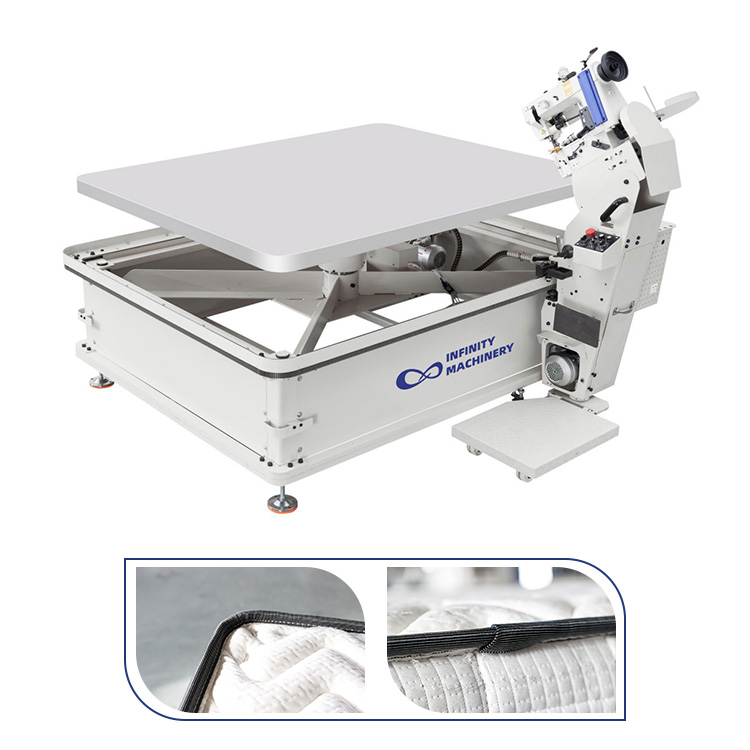
The pillow-top mattress is the premium product and the hard sewing problem, and the 350-millimeter thick cover is the edge that stalls the standard sewing head. The pillow-top cover stacks the top pad, the fill and the border into the thick edge, the standard head with the small clearance and the weak feed catches and stalls on the bulk, and the stalled machine stops the border line while the operator wrestles the cover, so the sewing head is the bottleneck of the pillow-top production. The heavy-duty head carries the thick edge: the IF-T3 Singer 300U Head Mattress Tape Edge Machine runs the classic Singer 300U head known for the thick-material penetration, the IF-T3T Chain Stitch High Speed Mattress Tape Edge Machine sews the chain stitch that feeds the thick cover without the puckering, and the IF-T2 Semi-Auto High Speed Mattress Tape Edge Machine combines the semi-automatic cycle with the clearance for the heavy covers, so the pillow-top line that matches the head to the thickness sews the 350-millimeter edge without the stall.
The pillow-top cover is the extreme test of the sewing head, and the demands of the thickness, the weight and the layers shape the head selection. The thickness demand is the first: the pillow-top edge stacks the top panel, the padding and the border tape into the 350 millimeters of the combined bulk, the head must accept the bulk under the presser and around the throat, and the small-clearance head catches and stalls on the bulk, so the thickness demand selects the head with the open throat and the high lift. The weight demand is the second: the heavy cover is awkward to hold and guide, the operator wrestles the weight around the four corners, and the head with the smooth feeding and the table support carries the weight, so the weight demand selects the head that moves the fabric instead of the operator. The layer demand is the third: the pillow-top seam joins the several layers of the different materials, the needle must penetrate the dense stack without the deflection, and the stitch must hold the thick seam without the break, so the layer demand selects the strong needle bar and the heavy thread path. The speed demand is the fourth: the pillow-top line produces the premium volume, the head that stalls at the thick corners slows the whole line, and the head that sews the thick edge at the steady rate keeps the output, so the speed demand selects the head that does not trade the thickness for the pace. The quality demand is the fifth: the pillow-top seam is the visible edge of the premium product, the straight seam and the even stitch are the quality the customer pays for, and the head that feeds evenly produces the straight seam, so the quality demand selects the head that holds the stitch at the thick edge. The demand rule: thickness, weight, layers, speed and quality are the five demands of the pillow-top cover, and the head that meets the five sews the premium product without the stall, the break or the wavy seam.
The sewing head type decides how the machine handles the thick cover, and the three types of the Singer 300U, the chain stitch and the high speed cover the pillow-top range. The Singer 300U head is the first type: the IF-T3 Singer 300U Head Mattress Tape Edge Machine carries the classic 300U head known for the thick-material penetration and the steady stitch, the design has powered the mattress border sewing for the decades, and the 300U head handles the heavy covers with the dependable feed, so the Singer 300U is the proven workhorse of the pillow-top border. The chain stitch head is the second type: the IF-T3T Chain Stitch High Speed Mattress Tape Edge Machine sews the chain stitch that feeds the thick cover smoothly, the chain stitch does not pull the layers into the pucker, and the stretch-tolerant seam holds the thick edge, so the chain stitch head suits the thick and the plush covers that the lock stitch would gather. The high-speed head is the third type: the IF-T2 Semi-Auto High Speed Mattress Tape Edge Machine runs the semi-automatic cycle with the clearance for the heavy covers, the operator controls the corners while the machine sews the straight runs, and the semi-auto balance fits the mixed production, so the high-speed head suits the factory that runs the pillow-top along the standard sizes. The compatibility is the fourth element: the head types share the machine frame and the table, the factory can switch the head for the product run, and the common frame keeps the spare parts and the training simple, so the compatibility gives the factory the flexibility of the two head types on the one machine. The head rule: the 300U for the dependable heavy feed, the chain stitch for the thick plush covers and the high speed for the mixed volume, and the factory that matches the head to the cover sews the pillow-top without the compromise.
The throat and the clearance are the physical fit of the thick edge, and the head that does not fit the bulk stalls before it sews. The throat space is the first dimension: the throat is the space between the needle and the machine frame, the 350-millimeter bulk must pass through the throat as the seam sews, and the small throat catches the bulk at the corner, so the throat space is checked against the thickest cover of the product range. The presser lift is the second dimension: the presser foot rises to accept the fabric, the high lift clears the 350-millimeter bulk at the start and the corner, and the low lift jams the cover under the foot, so the presser lift is checked against the material height. The needle bar travel is the third dimension: the needle bar strokes the needle through the layers, the long stroke penetrates the deep stack and the short stroke misses the bottom layer, and the stroke is matched to the stack thickness, so the needle bar travel is the penetration check of the thick seam. The table support is the fourth element: the extended table supports the heavy cover at the sewing height, the sliding table lets the operator turn the bulk without the lift, and the supported table reduces the operator fatigue, so the table support carries the weight that the arms would otherwise hold. The guide clearance is the fifth element: the edge guide is adjustable for the thick cover, the guide holds the 350-millimeter edge straight without the binding, and the adjusted guide feeds the thick edge at the constant position, so the guide clearance keeps the seam straight on the thick run. The fit rule: check the throat, the presser lift, the needle travel, the table support and the guide clearance, and the factory that fits the five to the 350-millimeter cover sews the edge without the stall from the first corner.
The feeding and the stitch are the motion of the thick cover, and the head that feeds and stitches the heavy fabric keeps the line moving. The feed mechanism is the first element: the walking foot or the compound feed moves the thick cover from the top and the bottom, the multiple feed points grip the heavy layers, and the gripped layers advance at the even rate, so the feed mechanism is the first answer to the stall. The stitch length is the second element: the thick cover takes the longer stitch, the long stitch penetrates and holds the dense stack, and the short stitch crowds and puckers the thick seam, so the stitch length is adjusted for the material. The thread path is the third element: the heavy cover needs the strong thread, the thread path carries the thick thread without the friction and the break, and the smooth path keeps the heavy thread flowing, so the thread path is the reliability of the thick seam. The needle system is the fourth element: the large needle with the sharp point penetrates the dense layers, the needle is matched to the thread and the material, and the matched system sews the clean stitch without the skipped loop, so the needle system is the penetration of the thick stack. The corner motion is the fifth element: the corner is where the stall happens, the operator lifts the presser, pivots the heavy cover and lowers the presser, and the machine with the smooth pivot and the quick re-entry sews the corner without the hesitation, so the corner motion is the rhythm of the pillow-top cycle. The motion rule: compound feed, long stitch, smooth thread, matched needle and the smooth corner, and the factory that sets the five keeps the heavy fabric moving and the stall out of the shift.
The selection decision matches the sewing head to the product mix, and the mix of the pillow-top, the standard and the plush covers decides the head and the machine. The product mix is the first factor: the factory that runs the pillow-top as the main line chooses the dedicated heavy-duty head, the factory that runs the pillow-top along the standard sizes chooses the high-speed semi-auto, and the mix share decides the head priority, so the product mix is the first question of the selection. The thickness range is the second factor: the factory measures the thickest cover of the range, the 350-millimeter pillow-top demands the full clearance and the 200-millimeter standard fits the normal head, and the head is selected for the thickest cover, so the thickness range sets the floor of the specification. The volume is the third factor: the pillow-top line at the high volume needs the high-speed head with the heavy-duty feed, the low volume can use the standard head with the slower pace, and the volume justifies the machine cost, so the volume decides the investment level. The stitch requirement is the fourth factor: the factory that sells the stretch and the plush covers chooses the chain stitch, the factory that sells the firm and the standard covers uses the lock stitch, and the customer requirement decides the stitch type, so the stitch requirement is the product-driven factor of the selection. The spares and the training are the fifth factor: the head with the common parts and the local training keeps the maintenance simple, the established head type like the Singer 300U has the parts everywhere, and the simple support keeps the line running, so the spares and the training favor the proven head. The selection rule: read the product mix, measure the thickest cover, check the volume, match the stitch to the market and favor the supported head, and the factory that runs the five buys the head that sews the pillow-top without the stall and the downtime.
Contact our team for the IF-T3, IF-T3T and IF-T2 tape edge machines with the heads and the clearances that handle your thickest cover.