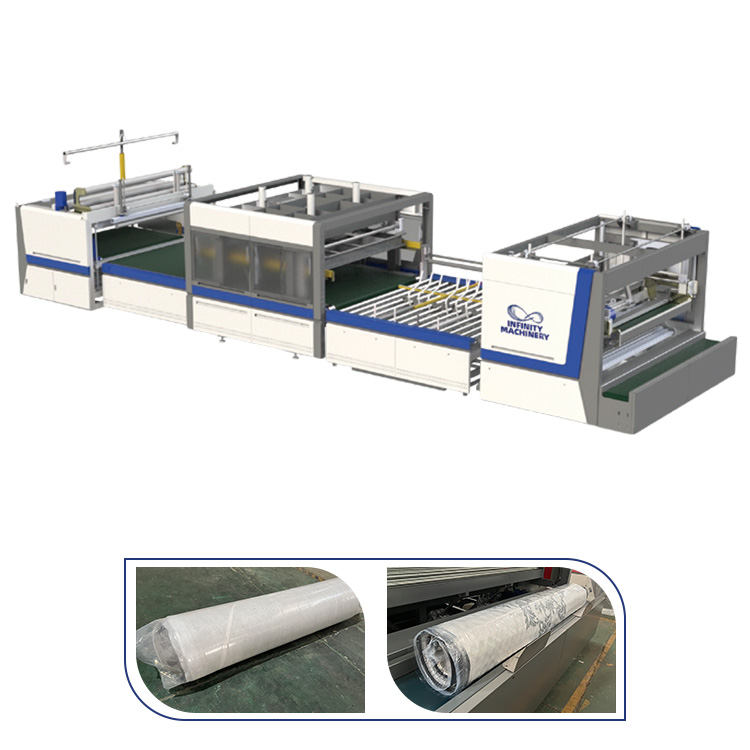
The mattress factory that exports the uncompressed mattress pays for the air, and the air is the biggest cost line in the container. The standard 40-foot container holds about 67 cubic meters, the uncompressed mattress occupies its full volume with the springs, the foam and the air inside, and the factory that ships the mattresses as they leave the line fills the container with the volume that is mostly air, so the freight per mattress carries the cost of the empty space. The compression changes the equation: the IF-CR8 Automatic Mattress Compression and Roll Packaging Machine squeezes the mattress into the fraction of the volume, the IF-AMB Automatic Mattress Packing Machine wraps, seals and packs the compressed mattress into the stable unit, and the IF-CR2 Automatic Mattress Roll Packing Machine rolls the mattress into the compact roll, so the container that carried the dozens of uncompressed mattresses carries the hundreds of compressed ones, and the freight per mattress drops with the air that leaves the box.
The exporter pays for the container volume, and the container volume of the uncompressed mattress is mostly air. The standard 40-foot high-cube container offers about 76 cubic meters of the usable space, the standard container about 67, and the freight quote is for the container, not for the mattress, so every cubic meter that the air occupies is the cubic meter that the product does not use. The uncompressed mattress is a three-dimensional object: the queen mattress measures about 1.6 meters by 2.0 meters by 0.25 meters of thickness, the volume is about 0.8 cubic meters, but the actual material, the springs, the foam, the fabric and the border, occupies only a small fraction of that box, because the springs hold the air and the foam holds the air, so the mattress is a structure of air with the material on the edges. The packing problem: the uncompressed mattress cannot be stacked efficiently, the soft body of the mattress compresses under the weight of the stack, the stack shifts and sways in the container, and the loading crew fills the space with the gaps that the rectangular mattress cannot cover, so the container leaves with the air between and around the mattresses. The freight math: the container rate for the ocean lane divided by the mattresses that fit, and the uncompressed loading fits the small number, so the freight per mattress is the container rate divided by the small count, and the air is the reason the count is small. The shipping rule: the uncompressed mattress pays for the volume of the air, and the exporter who measures the air sees the first cost of the uncompressed export.
The uncompressed mattress loses money in three places: the volume loss, the handling loss and the damage loss, and the exporter who counts the three sees the real cost of the uncompressed export. The volume loss is the first: the uncompressed mattress takes the full box of air, the container carries the small count, and the freight per mattress is high because the volume is wasted, so the volume loss is the container efficiency that the compression restores. The handling loss is the second: the uncompressed mattress is bulky and soft, the loading crew handles the awkward piece, the mattress bends and sags during the loading, the container space around the stack is hard to use, and the handling time per mattress is long, so the labor cost of the loading rises with the bulk of the product. The damage loss is the third: the uncompressed mattress moves inside the container, the shifting stack rubs against the walls and the other mattresses, the fabric snags and the corners crush, and the damaged mattress arrives at the customer with the claim and the return, so the damage cost adds the replacement and the lost trust to the freight bill. The warehousing loss is the fourth: the uncompressed mattress needs the large warehouse volume, the storage rack holds the small number per bay, and the warehouse rent per mattress is high, so the air that is expensive in the container is also expensive in the warehouse. The insurance loss is the fifth: the cargo insurance premium follows the value and the risk, the uncompressed cargo has the higher damage risk and the higher claim frequency, and the premium per container rises with the risk, so the uncompressed shipment pays the higher insurance along with the higher freight. The loss rule: volume, handling, damage, warehousing and insurance are the five losses of the uncompressed mattress, and the exporter who adds the five sees that the air costs money in every step of the journey.
The compression turns the air-filled mattress into the dense unit, and the density math of the container changes with the compression ratio. The compression ratio is the first number: the mattress compression machine presses the mattress under the controlled pressure, the queen mattress that starts at 25 centimeters of thickness becomes the few centimeters, the volume shrinks to the fraction of the original, and the compression ratio of the 3 to 1 or the 5 to 1 is the multiplication factor of the container. The roll packing is the second number: the compressed mattress is rolled into the cylinder, the roll is the stable package that stands and stacks, the roll diameter and the length are the predictable dimensions, and the predictable roll loads the container with the minimal gaps, so the roll packing combines the compression with the efficient geometry. The recovery is the third number: the compressed mattress is designed to recover after the unpacking, the springs and the foam return to the shape when the vacuum seal opens, and the recovery time of the minutes to the hours depends on the material, so the exporter tests the recovery time before the mass production. The density math is the fourth number: the container of the uncompressed mattresses holds the dozens, the container of the compressed rolls holds the hundreds, the multiplication factor of 3 to 5 times the count, and the freight per mattress divides by the same factor, so the density is the direct lever of the freight cost. The weight check is the fifth number: the compression does not change the weight of the mattress, the container that fills with the compressed rolls reaches the weight limit before the volume limit, and the exporter balances the count against the weight limit of the road and the ocean leg, so the density gain is limited by the weight where the mattress is heavy. The density rule: the compression multiplies the count per container by the ratio, the weight limit caps the gain, and the exporter who calculates the count at the volume and the weight limit knows the real fit of the container.
The exporter chooses the packing method, and the method decides the compression quality, the speed and the labor of the shipping line. The manual wrap is the first option: the crew wraps the mattress in the film by hand, the manual compression with the straps or the vacuum gives the inconsistent result, and the manual line is slow and labor heavy, so the manual wrap fits the small volume and the occasional shipment. The semi-automatic option is the second: the semi-automatic roll packing machine feeds the mattress into the compression chamber and the rolling mechanism, the operator supervises the cycle, and the semi-automatic line handles the medium volume with the consistent compression, so the semi option is the step up from the manual line. The automatic option is the third: the IF-CR8 Automatic Compression and Roll Packaging Machine runs the compression, the wrapping, the sealing and the rolling in the automatic cycle, the operator loads the mattress and the machine finishes the unit, and the automatic line reaches the high volume with the uniform package, so the automatic option removes the labor and the variance from the packing step. The full line option is the fourth: the IF-AMB Automatic Mattress Packing Machine integrates the wrapping, the sealing, the compression and the folding or the rolling into the packing line, the mattress enters and the packed unit exits, and the full line feeds the container directly, so the full option matches the factory that packs in the continuous flow. The roll option is the fifth: the IF-CR2 Automatic Mattress Roll Packing Machine specializes in the rolled mattress for the bed-in-a-box, the compact roll loads the container with the maximum density, and the roll option suits the product that ships to the consumer market, so the roll machine is the volume champion of the container. The option rule: manual for the small volume, semi for the medium, automatic for the high, and the full line for the continuous flow, and the exporter who matches the method to the volume pays for the packing only what the volume demands.
The shipping decision comes down to the per-container cost, and the exporter who runs the math with and without the compression sees the payback of the packing line. The uncompressed scenario is the first number: the 40-foot container carries the 80 uncompressed mattresses of the queen size, the container rate of the 4,000 dollars gives the freight of 50 dollars per mattress, and the warehouse, the handling and the damage add the cost on top, so the uncompressed scenario pays the high per-mattress cost. The compressed scenario is the second number: the same container carries the 240 compressed rolls, the same 4,000 dollars gives the freight of about 17 dollars per mattress, and the saving of the 33 dollars per mattress is the direct gain of the compression, so the compressed scenario pays the freight of the fraction. The line payback is the third number: the automatic packing machine costs the investment, the line packs the mattresses at the production rate, and the saving per mattress times the volume per month gives the monthly saving, so the investment divides by the monthly saving into the payback period. The volume threshold is the fourth number: the exporter who ships the few containers a year may keep the manual wrap because the machine payback stretches beyond the horizon, while the exporter who ships the many containers sees the line pay back in the months, so the volume decides whether the compression investment makes the sense. The price advantage is the fifth number: the compressed exporter quotes the lower landed cost to the buyer, the lower freight widens the margin or lowers the price, and the landed cost advantage wins the orders against the uncompressed competitor, so the compression is not only the cost saving but the pricing weapon. The decision rule: run the uncompressed and the compressed per-mattress cost, multiply by the monthly volume, and compare the payback against the shipping horizon, and the exporter who runs the math knows exactly when the packing line pays for itself.
Contact our team for the IF-CR8, IF-AMB and IF-CR2 packing lines with the compression ratios and the speeds that match your export volume.